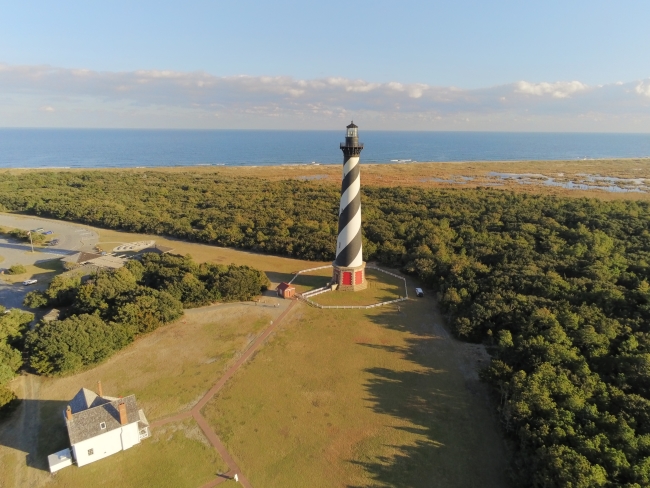
North Carolina’s Cape Hatteras Lighthouse is the tallest traditional lighthouse in the United States. Built in 1870, the lighthouse is located on Hatteras Island near Cape Hatteras, after which it is named. It is located approximately in the middle of Cape Hatteras National Seashore.
As is true for many lighthouses, the Cape Hatteras Lighthouse was once threatened due to land erosion. In 1999, the lighthouse was relocated 2,900 feet inland to a new site. The 23-day relocation placed the lighthouse 1,500 feet from the seashore, which, according to the National Park Service, was its original distance from the sea before the impact of seashore erosion.
In 1978, the lighthouse was listed on the National Register of Historic Places and was classified as a National Historic Landmark in 1998.
In 2023, it was announced that a $19.2 million contract was awarded to begin a restoration project of the lighthouse.
The Green Light Blog recently recently conducted an email Q&A with the Cape Hatteras National Seashore to learn more about the Cape Hatteras Lighthouse Restoration Project.
Could you share some details about the Cape Hatteras Lighthouse restoration project?
The $19.2 million Cape Hatteras Lighthouse restoration project is an 18-month project that will rehabilitate the interior and restore the exterior of the lighthouse, repair and replace deteriorated materials and finishes and provide landscape improvements to enhance the visitor experience. Additionally, the project includes the fabrication of a replica first-order Fresnel lens.
The following will be performed inside and outside of the Cape Hatteras Lighthouse during the project:
- Rehabilitate the interior and restore the exterior of the lighthouse.
- Repaint the interior and exterior of the lighthouse.
- Restore important architectural components, including missing pediments over the lighthouse windows and missing interior doors.
- Repair and repoint masonry, remove corrosion and repair metal elements.
- Remove the metal weight track from the lighthouse.
- Install new railing using a non-corrosive metal on the lantern balcony.
- Remove existing rotating light beacon and metal platform from the lantern and replace with a replica of the original first-order Fresnel lens. The replica lens will be the same size and overall appearance as the original, but LED lights will be used inside the lens.
- Rehabilitate and repair the Oil House.
- Remove the existing vinyl perimeter fence around the lighthouse and replace with a replica of the original (pre-1920) decorative metal octagonal fence with granite bases.
- Fabricate and install a replica stockade fence around both the Principal Keeper’s Quarters and Double Keepers’ Quarters (Museum of the Sea) to match the look and feel of the original landscape of the early historic period (1870-1890s).
- Create a new walkway from the parking lot to improve pedestrian circulation, wayfinding, interpretation and the visitor experience.
- Relocate the Keepers of the Light Amphitheater stones to provide interpretation of the lighthouse keeper’s role.
You can learn more at http://go.nps.gov/cahalighthouserestoration.
What inspired this specific lighthouse restoration effort?
The Cape Hatteras Lighthouse is located on a barrier island along the Atlantic coast and is exposed to salt air, high winds and intense sunlight. Consequently, repairs are needed to maintain the integrity of this national treasure. The multi-year project is a result of findings from a 2014 Comprehensive Condition Assessment Report and a 2016 Historic Structure Report.
How did you go about securing funding and support for your restoration project?
The project is funded through a combination of Line-Item Construction (LIC) funds and fee revenues collected by Cape Hatteras National Seashore. LIC is the list of construction projects that are appropriated funds by project name each budget year; the list is made up of National Park Service requested and congressionally requested projects.
What are the main steps you’ve taken so far in planning and organizing the restoration process?
After a lengthy design and public review process, Cape Hatteras National Seashore selected Stone & Lime Historic Restoration Services, Inc. to perform the work inside and outside the Cape Hatteras Lighthouse.
The key highlights of the first phase of the project include:
- Construction fencing will be installed around the limit of construction which includes an area beyond the current lighthouse fencing, construction entrances adjacent to the parking lot, and landscape improvements [COMPLETED]. The site will have limited access for visitation and viewpoints.
- The Keepers of the Light Amphitheater stones will be removed and stored in a secure location for the duration of the project [COMPLETED]. The stones will be placed in the lighthouse district when the construction is completed to honor the keepers and educate the public about their role in caring for the lighthouse.
- The primary construction entrance will be located east of the current main entrance to the light station. A portion of the parking area will be closed for several months for the delivery of project materials and staging for construction [IN PROGRESS].
- Scaffolding will be delivered and erected around the exterior and interior of the lighthouse in the coming weeks.
Have you encountered any unique challenges or obstacles during the early stages of the project?
Nothing notable. The project is at a very early phase.
What are your goals and aspirations for the restored lighthouse once the project is completed?
The current restoration project represents one of the largest efforts to repair and restore this American icon. Cape Hatteras National Seashore is continuing the important tradition of stewardship through this significant investment that will restore the lighthouse’s condition and bring back character defining architectural features as they were in 1870. In addition to the restoration work, improvements to the landscape will result in a more enjoyable and immersive experience.
Could you provide some insights into the timeline and estimated completion date for the restoration work?
The project is expected to take at least 18 months. At the end of the project, there will be a ribbon-cutting ceremony and seasonal lighthouse climbing will resume. We do not expect climbing opportunities to be possible until the summer of 2026.
Other info that may be of interest to your readers and potential visitors:
Visitors to the site should expect the entire area to be under construction for a minimum of eighteen months. Access to the Cape Hatteras Light Station will vary through the course of the project and temporary closures will occur. Additionally, the exterior of the lighthouse will be scaffolded for the duration of the project. A temporary beacon will be installed on the exterior of the lighthouse during the project, though there will be periods of time that the light is turned off due to construction.

 The Green Light Blog